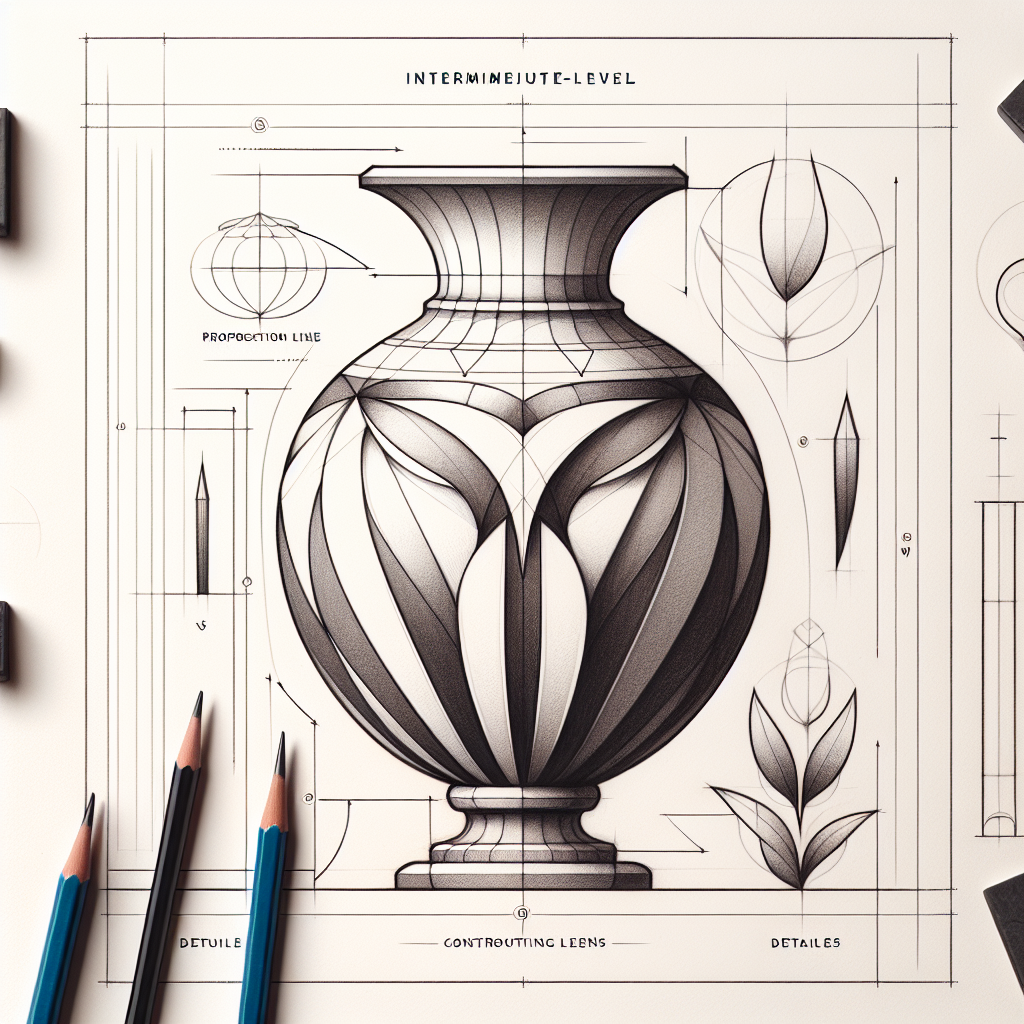
What you'll learn
Drawing a decorative vase provides an opportunity to study the symmetry and proportion of curved forms. Capturing the volume requires careful attention to the contours that define its three-dimensional shape.
What you'll need
Step-by-step: how to draw decorative vase
Begin by lightly sketching the central axis of the vase to ensure symmetry and balance.
Outline the major contours of the vase, paying attention to the proportions between the neck, body, and base.
Refine the contours by adjusting the curves to capture the volume and dimensionality of the vase.
Add subtle shading along the contours to emphasize the roundness and depth of the form.
Pro tips for drawing decorative vase
Self-evaluation checklist
Check that the vase's proportions are consistent along the central axis and that the contours convincingly portray the object's roundness and depth.
Frequently asked questions
How long does this drawing exercise take?
The full decorative vase exercise is designed to fit in about 10 minutes of focused practice — one of the reasons it works as a daily habit.
Do I need any prior drawing experience?
No. This lesson is aimed at intermediate artists and assumes only a pencil, paper, and willingness to observe.
What skill does this lesson target?
The focus is proportion & volume. Repeating similar exercises over time is how this skill becomes second nature.
More drawing lessons
Get a new drawing lesson delivered to your inbox every morning — free.
Subscribe to Draw Daily →